
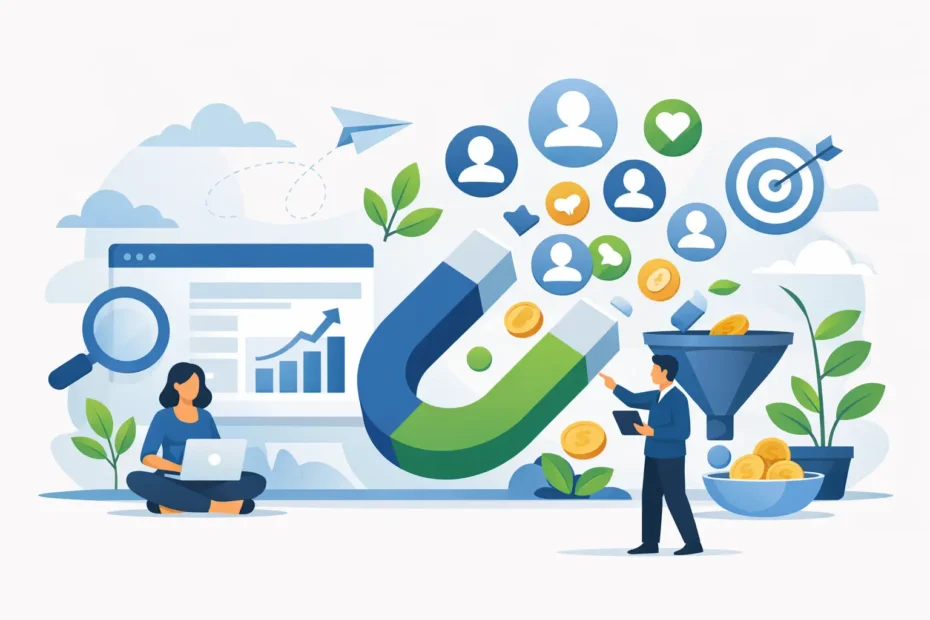
Most businesses do not have a traffic problem. They have a conversion problem, a positioning problem, or a visibility problem. If you are trying to figure out how to generate leads organically, the real question is not how to get more random visitors. It is how to attract the right people, at the right time, with the right intent, and move them toward an inquiry without paying for every click.
That is where organic lead generation gets valuable. Done properly, it compounds. One strong page can bring in inquiries for months. One well-built SEO strategy can keep producing qualified traffic while your competitors keep feeding the ad platforms. No B.S. – organic leads are slower to build than paid ads, but they are usually more durable, more cost-efficient over time, and often higher intent.
What how to generate leads organically really means
Organic lead generation is not just blogging and hoping for the best. It is the process of earning visibility through search, content, local presence, and trust signals so potential customers find you naturally. Then your website does the heavy lifting by turning that visibility into calls, form submissions, and sales conversations.
For most SMEs, this means your website needs to function like a salesperson, not a brochure. If your pages are vague, slow, thin, or built around what you want to say instead of what buyers want to know, you will attract little traffic or the wrong traffic. Worse, you may get visitors who never convert.
That is why the businesses winning organic leads are not always the biggest. They are usually the clearest. They show up for the right searches, speak directly to buyer intent, and make the next step obvious.
Start with buyer intent, not content volume
A common mistake is publishing lots of content with no commercial strategy behind it. More pages do not automatically mean more leads. If the topics attract students, job seekers, or casual browsers, your traffic may go up while revenue stays flat.
If you want to know how to generate leads organically in a way that actually grows the business, start by identifying what your ideal customer searches before contacting a provider. These are not always broad, high-volume keywords. In many cases, the better opportunities are specific, lower-volume searches with strong intent.
For example, someone searching “SEO agency” may be browsing. Someone searching “SEO consultant for law firm” or “technical SEO service for ecommerce site” is much closer to action. The second group is smaller, but far more valuable.
This is where strategy matters. You want a keyword map built around revenue opportunities, not vanity traffic. Service pages, location pages, comparison pages, and problem-aware educational content all play different roles. Some pages capture direct intent. Others warm up buyers who are still evaluating options.
Your service pages should do more selling
Many websites bury their best chance of getting leads. Their service pages are generic, padded with fluff, and say the same thing every competitor says. If your page could have your logo removed and still apply to ten other companies, it is not doing enough.
A lead-generating service page needs to be specific. It should explain who the service is for, what problems it solves, what outcomes matter, and why your approach is different. It should answer the objections a serious buyer already has in mind – timeline, pricing model, fit, process, and expected business impact.
This is where many businesses lose money. They invest in SEO to get traffic, but the pages receiving that traffic are weak. Organic growth is not just about ranking. It is about ranking pages that can close.
If you offer multiple services, each one deserves its own focused page. If you serve multiple areas or industries, that may require separate pages too. Not because more pages are always better, but because relevance wins. Search engines reward clarity, and so do buyers.
Content should support revenue, not distract from it
Content marketing still works, but only when it supports a clear commercial path. Too many brands publish content that educates without converting. They answer interesting questions, get some traffic, and then wonder why the phone is still quiet.
The better approach is to create content around buying triggers. Think about the questions prospects ask before they hire someone. Think about the risks they are trying to avoid, the comparisons they make, and the proof they need before reaching out.
That means practical topics tend to perform better than vague thought leadership. Articles such as pricing guides, service comparisons, industry-specific use cases, timeline expectations, common mistakes, and solution-focused explainers can pull in visitors who are already moving toward a decision.
You do not need a bloated editorial calendar. You need content with a job. One article might attract search traffic. Another might build authority. Another might support a service page by answering a key objection. The point is not volume. The point is movement toward a lead.
SEO is still the engine behind organic leads
If your business depends on inbound inquiries, search visibility is not optional. People go to Google when they want solutions. Increasingly, they also rely on AI-generated answers and search summaries. If your business is absent from both, you are invisible during critical buying moments.
Strong SEO means more than inserting keywords into pages. It includes technical performance, crawlability, site structure, internal linking, local relevance, content depth, topical authority, and conversion alignment. It also means understanding how search behavior changes when users ask longer, more specific questions.
This matters because organic lead generation is not won by tricks. It is won by building the kind of site that search engines trust and buyers understand quickly. Fast load speed helps. Clear navigation helps. Structured content helps. Useful pages that match search intent help most.
For local businesses, local SEO can produce some of the highest-converting organic leads available. Ranking in map results and localized searches often brings in prospects who are ready to contact a provider now, not later. If you operate in a competitive market, your local presence needs to be treated like a revenue channel, not a side task.
Trust is the conversion multiplier
Even when you rank well, people will not inquire if your website feels risky. Organic leads are earned through trust as much as visibility. Buyers are asking themselves simple questions: Are you credible? Do you understand my problem? Can I trust you with budget and outcomes?
That is why testimonials, case studies, founder visibility, process clarity, and proof of results matter. If you make bold claims, support them. If you position yourself as premium, explain why. If you are selective about client fit, say so clearly. Serious buyers are not scared off by standards. In many cases, they prefer them.
The strongest lead-gen websites reduce uncertainty. They make it easy for a visitor to understand what happens next. They show evidence. They sound like a real operator, not a template-driven agency trying to please everyone.
How to generate leads organically without waiting forever
Organic lead generation takes time, but that does not mean you wait passively. The smart move is to prioritize the assets most likely to produce near-term inquiry growth.
Usually, that starts with fixing your money pages first. Upgrade your main service pages. Tighten your offer. Improve calls to action. Add proof. Then build supporting content around the highest-intent searches. After that, address technical SEO issues that may be holding the site back. If local visibility matters, strengthen your location signals and business profile.
This order matters. Publishing ten blog posts on a weak site rarely moves the needle. Improving the pages closest to revenue often does.
It also depends on your business model. A local service company may get faster returns from location pages and Google Business Profile optimization. A B2B consultancy may benefit more from high-intent service pages and authority content. An ecommerce brand may need category page SEO and technical improvements before content expansion makes sense.
There is no one-size-fits-all playbook. That is exactly why generic retainers often underperform. Organic lead generation works best when the strategy matches the buying behavior, sales cycle, and margin structure of the business.
The businesses that win treat organic like an asset
The reason organic lead generation outperforms over time is simple. Every useful page, ranking position, internal link, review, and trust signal becomes part of a larger system. You are not renting attention. You are building an asset that can produce opportunities around the clock.
That is also why weak execution is expensive. If your SEO brings in the wrong traffic, your content attracts the wrong audience, or your website fails to convert, the whole system leaks. You do not need more marketing noise. You need a strategy that turns visibility into qualified inquiries and qualified inquiries into revenue.
At https://www.robinooi.com.my/, that is the standard. Not more traffic for the sake of reports. Not generic SEO activity dressed up as progress. The goal is profitable visibility and a website that works like a 24/7 lead magnet.
If you are serious about how to generate leads organically, stop asking how to get seen by everyone. Start building a site that gets chosen by the right people.


