
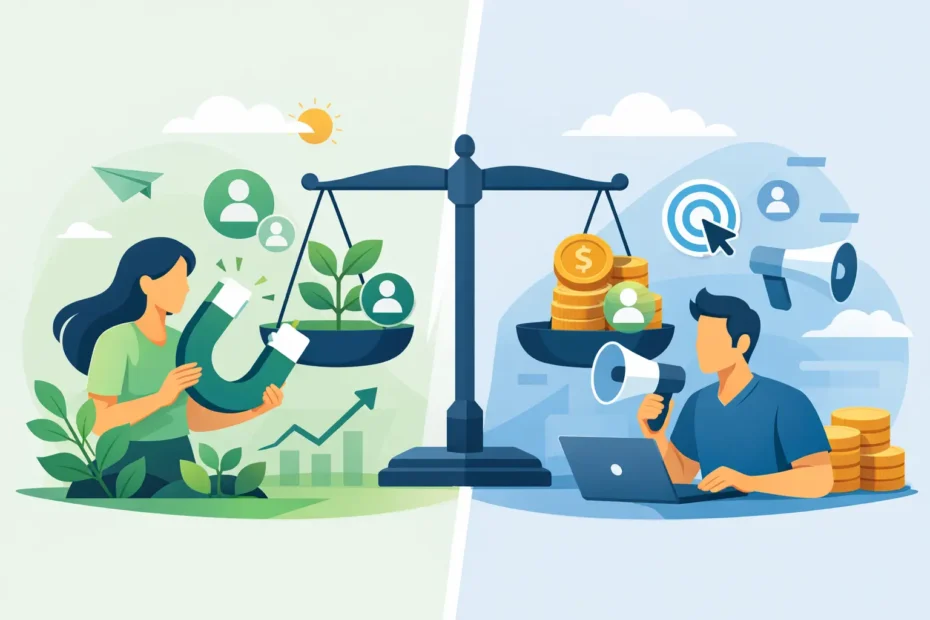
If your pipeline feels unpredictable, this is usually where the money leaks. A lot of businesses argue about organic leads vs paid leads as if one channel is automatically better. It is not that simple. The real question is which source gives you qualified inquiries at a cost and speed that make sense for your business.
For most companies, the wrong move is not choosing organic or paid. The wrong move is treating lead generation like a guessing game, then wondering why revenue is inconsistent. If you care about ROI, sales quality, and long-term growth, you need to understand what each channel is actually good at.
Organic leads vs paid leads: the real difference
Organic leads come from unpaid visibility. That includes SEO, local search, Google Business Profile visibility, content, referrals from search-driven discovery, and in some cases visibility inside AI-generated search experiences. These leads find you because your business shows up when they are actively researching a solution.
Paid leads come from advertising. Think Google Ads, Meta ads, LinkedIn campaigns, YouTube ads, display retargeting, and lead generation campaigns on various platforms. You pay to put your offer in front of a targeted audience, and if the campaign is well built, some of that attention turns into inquiries.
The difference is not just traffic source. It is buyer intent, cost structure, speed, and staying power.
Paid gets you visibility fast. Organic earns you visibility over time. Paid can stop the moment budget stops. Organic can keep producing after the initial work is done. Paid is often easier to scale quickly. Organic often becomes more cost-efficient once it gains traction.
That is why smart operators do not ask, “Which one is best in general?” They ask, “Which one fits my sales cycle, margins, and growth stage right now?”
When paid leads make more sense
If you need demand now, paid usually gets the first look.
A new business with no search visibility cannot wait six months for rankings if payroll depends on sales this quarter. A company entering a new market may need fast data on which offers convert. A seasonal business may need to capture demand during a narrow buying window. In these situations, paid lead generation gives you speed.
That speed has value. You can test offers, landing pages, pricing angles, and audiences much faster than you can through SEO alone. You can also push high-intent keywords and commercial searches immediately, especially if your website is not yet strong enough to rank organically.
But paid leads come with pressure. If your campaign targeting is loose, your landing page is weak, or your sales process is slow, your cost per lead climbs fast. Plenty of businesses say ads do not work when the real issue is that the funnel is badly built. Traffic is not the same as conversion.
Paid also gets more expensive in competitive markets. If several businesses are bidding on the same commercial keywords, cost per click rises. That means your economics matter. If your margins are thin or your close rates are poor, paid acquisition can become brutal.
When organic leads make more sense
Organic lead generation is the stronger play when you want durable growth and compounding ROI.
A good SEO strategy helps your business show up when prospects are actively searching for solutions, comparing providers, and checking credibility before they contact you. Those leads often arrive better informed. They have read your service pages, reviewed your expertise, and pre-qualified themselves before filling out a form or calling.
That usually improves lead quality.
Not every organic lead is perfect, of course. Informational traffic can be broad, and weak keyword targeting can bring in visitors who will never buy. But when SEO is built around commercial intent, service relevance, and local visibility, organic can become one of the most profitable channels in your business.
This is especially true for service-based companies, B2B firms, professional providers, and local businesses where trust matters. Buyers in these categories do not usually convert because they saw one ad once. They convert because they believe you are the right choice.
Organic helps build that belief at scale.
The catch is patience. SEO does not reward panic. It takes strategy, technical cleanup, content planning, authority building, and ongoing refinement. If you expect instant results, you will get frustrated. If you treat it like a real asset, it can turn your website into a 24/7 lead magnet.
Lead quality: where most businesses get it wrong
Businesses often compare channels only by cost per lead. That is lazy math.
A cheaper lead is not better if it never closes. A more expensive lead can be far more profitable if it has strong intent, better budget fit, and shorter sales friction.
Paid leads can range from excellent to terrible depending on campaign structure. Search ads targeting bottom-of-funnel terms often perform well because intent is clear. Social lead campaigns can produce volume, but volume is not the same as quality. If someone filled out a form because the barrier was low, your sales team may spend more time chasing than closing.
Organic leads often arrive with stronger trust because the buyer discovered you during their own research process. That matters. People trust what they find more than what interrupts them. In many industries, that trust translates into better close rates.
Still, it depends on the business model. If you sell a simple offer with a short decision cycle, paid may convert efficiently at scale. If you sell high-trust services with a longer evaluation process, organic usually carries more weight.
Cost and ROI over time
This is where organic leads vs paid leads becomes a serious business decision instead of a marketing debate.
Paid leads are straightforward. You spend money, you get traffic, and if the system works, you get leads. That makes performance easier to track in the short term. The problem is dependency. The moment you stop spending, lead flow can collapse.
Organic requires investment upfront, but the economics improve over time if the strategy is sound. A page that ranks well for a high-intent search can bring in leads for months or years. That does not mean SEO is free. It means the marginal cost per additional lead often drops as your visibility compounds.
For owners thinking beyond the next 30 days, that matters a lot.
If your business relies only on paid acquisition, you are renting attention. If your business builds strong organic visibility, you are building an asset. One is useful. The other is defensible.
The best strategy is usually not either-or
Most serious growth businesses should not choose one side blindly.
Paid is excellent for speed, testing, and filling short-term gaps. Organic is excellent for trust, stability, and long-term lead economics. Used together, they can do more than either channel alone.
Paid campaigns can tell you which keywords, offers, and landing pages convert fastest. That data can sharpen your SEO strategy. Organic content can warm up prospects before they click an ad or convert through retargeting later. SEO can lower your dependency on ad spend over time, while ads can support commercial visibility in competitive search results where organic ranking takes longer.
This is how mature lead generation works. Not random tactics. Not vanity traffic. A system.
How to decide what your business needs now
Start with your constraints.
If you need leads this month, have budget available, and your margins can support testing, paid should be part of the plan. If your ad funnel is not converting, fix that before increasing spend.
If your website barely ranks, your competitors dominate search, and your business needs a more stable pipeline, organic should become a priority. The longer you delay SEO, the longer you stay dependent on rented traffic.
If your close rates are weak, neither channel will save you. Lead generation is only half the equation. Your website, offer, response speed, and sales process all affect the result.
This is also where outside expertise matters. Too many businesses buy isolated tactics when what they need is channel strategy tied to revenue. That is the difference between getting activity and getting outcomes.
For companies that want profitable traffic instead of empty reports, a tailored search strategy can identify where paid should accelerate growth and where organic should build leverage. That is the kind of work done at https://www.robinooi.com.my/ – focused on qualified leads, not feel-good metrics.
What winning businesses understand
The businesses that dominate their category do not obsess over traffic for its own sake. They care about qualified demand, conversion efficiency, and long-term control over customer acquisition.
That is the real answer to organic leads vs paid leads.
Paid can buy speed. Organic can build momentum. Paid can open the tap. Organic can keep it flowing. If you treat both as tools instead of identities, you make better decisions and waste less money.
The smartest move is to stop asking which channel sounds better and start asking which one produces profitable inquiries for your business right now, while building a stronger position six months from now.


