
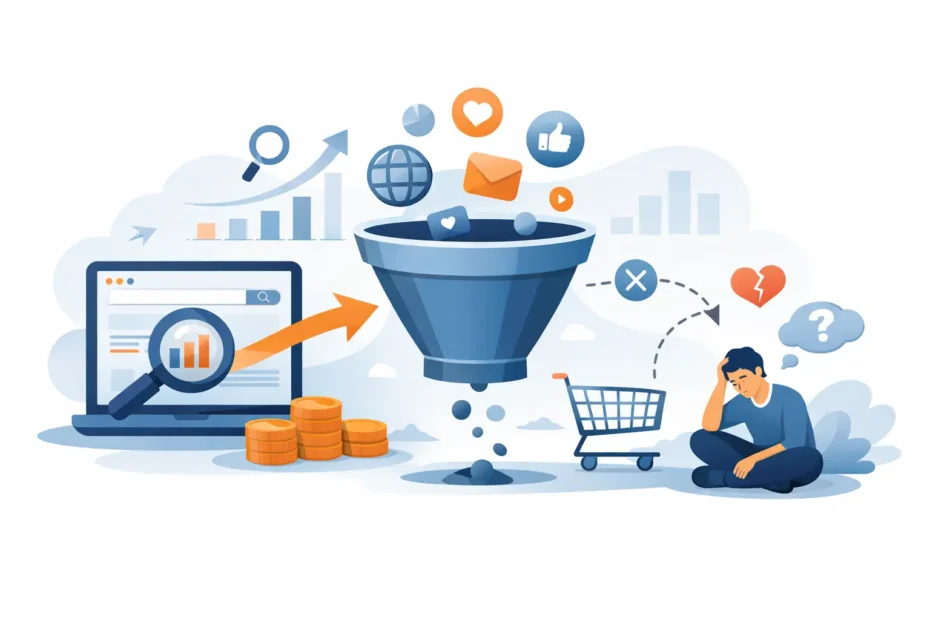
You check your rankings, see organic traffic climbing, and still hear the same ugly sentence in the sales meeting: “We’re getting visitors, but not enough leads.” That is exactly why SEO traffic is not converting becomes the question that actually matters. Traffic without revenue is noise. If your website is attracting people but not turning them into inquiries, calls, or sales, the problem usually is not SEO alone. It is the gap between visibility and buying intent.
A lot of business owners get sold the wrong scoreboard. They are told to celebrate impressions, sessions, and keyword positions. Those numbers can be useful, but they do not pay salaries. If the people landing on your site are not the right fit, do not trust your offer, or do not know what to do next, more traffic just means more waste.
Why SEO traffic is not converting in the first place
The biggest mistake is assuming traffic quality and traffic volume are the same thing. They are not. You can rank for broad terms, attract curious visitors, and still generate almost no commercial action. A site can look healthy in analytics while being weak where it counts – qualified leads and sales conversations.
This usually shows up in one of three ways. First, your pages are ranking for informational searches when your business needs buyer-ready searches. Second, your offer is not clear enough to move people from interest to action. Third, your website creates friction at the exact moment someone is ready to contact you.
That means the issue is rarely, “SEO does not work.” The issue is that your SEO strategy, website messaging, and conversion path are not aligned.
You are ranking for the wrong intent
This is the most common reason SEO underperforms commercially. A keyword can bring traffic and still be the wrong keyword for your business goals.
Let’s say you sell B2B services. If your content pulls in people searching basic definitions, free templates, or beginner how-to advice, you may get visits from students, researchers, or early-stage browsers. They inflate your analytics, but they are not ready to buy. A lot of agencies chase easy wins in rankings because traffic graphs look impressive. Business owners then wonder why the phone stays quiet.
Commercial SEO requires intent mapping. Some keywords signal research. Some signal comparison. Some signal urgency. If your strategy is built around low-intent traffic, conversion rates will disappoint no matter how much content you publish.
There is a trade-off here. Informational content is not useless. It can build authority and support long-term visibility. But if most of your SEO campaign is attracting people far away from a buying decision, you do not have a lead generation system. You have a publishing hobby.
Your page does not match the searcher’s expectation
Getting the click is only step one. After that, your page has to confirm the visitor is in the right place.
If someone searches for a specific service and lands on a vague page full of generic claims, trust drops fast. If they search with urgency and hit a page that forces them to dig for basic details, they leave. If your page title promises one thing and the content delivers another, you create confusion before the conversation even starts.
This is where many businesses lose qualified traffic. The keyword targeting may be decent, but the landing experience is weak. The visitor cannot quickly answer the questions that matter: What exactly do you do? Who is it for? Why should I trust you? What happens next if I contact you?
No B.S. – if those answers are buried, fluffy, or missing, conversions suffer.
Your website talks about you, not the buyer
Many websites sound like a company profile instead of a sales asset. They spend too much time talking about being passionate, experienced, and customer-focused. That language is everywhere, which means it says nothing.
Buyers want relevance. They want to know whether you solve their specific problem, how your process works, how fast they can expect movement, and whether you understand the stakes. A director looking for more leads does not want a lecture on your company values. They want confidence that you can improve outcomes.
This is one reason why SEO traffic is not converting even when rankings are solid. The search engine delivered the visitor, but the copy failed to close the gap between interest and action.
Strong conversion copy does not need to be clever. It needs to be sharp. It should speak to pain, urgency, cost of delay, and business results. Especially in competitive service markets, clarity beats creativity.
The offer is weak or too vague
Sometimes the site is getting the right visitors, but there is no compelling next step. “Contact us” on its own is not a real offer. It is an instruction.
A stronger offer gives people a reason to act now. That could be a consultation, audit, strategy session, quote request, or direct booking. The exact format depends on your business model, sales cycle, and lead value. A local service business may do well with quote-driven pages. A higher-ticket B2B consultancy may convert better with a diagnostic call.
What matters is specificity. If the visitor cannot see what they get by reaching out, hesitation wins.
There is also a trust trade-off. Asking for too much too early can reduce inquiries. A long form, aggressive sales language, or hard commitment can scare off good prospects. On the other hand, making the offer too soft can attract low-quality leads. The sweet spot is a next step that feels valuable, credible, and low-friction.
Your site creates friction at the point of action
A surprising amount of organic traffic dies at the final step because the website makes responding harder than it should be.
Slow pages, poor mobile layout, weak calls to action, hard-to-find contact details, clunky forms, and too many distractions all hurt conversion. This is especially expensive on mobile, where a large share of SEO traffic now lands first. If your site looks fine on desktop but feels annoying on a phone, you are leaking leads every day.
Business owners often underestimate how unforgiving this stage is. A visitor who came from search did not arrive with guaranteed loyalty. They are comparing options. If your competitor makes it easier to trust them and contact them, they win.
You have traffic, but not enough proof
Search brings strangers. Strangers need evidence.
If your pages make strong promises without backing them up, visitors hesitate. They want proof that you can deliver. That proof can come from case examples, testimonials, process transparency, before-and-after outcomes, industry experience, or simply a more credible explanation of how results are achieved.
This is especially critical for service businesses, where the “product” is trust. If your site asks for a call but does not reduce perceived risk, many good prospects will leave and keep shopping.
You do not need to overload pages with hype. In fact, too much chest-thumping can backfire. But you do need enough evidence to answer the silent question every serious buyer has: Why should I believe you?
Analytics may be hiding the real problem
Sometimes traffic is converting, just not in the way you are tracking. Other times it is failing badly, but no one can see where.
If your analytics setup is messy, you might be making decisions off partial data. Maybe calls are not tracked. Maybe form submissions are broken. Maybe key pages have high exit rates that no one has reviewed. Maybe organic visitors return later through direct traffic and get credited elsewhere.
Without clean conversion tracking, businesses often either panic too early or stay comfortable too long. Neither helps.
Good SEO should be tied to pipeline thinking. Which pages attract qualified visitors? Which keywords lead to inquiries? Which entry points lead to closed business? If you cannot answer that, you are optimizing blind.
How to fix it without wasting another six months
Start by separating vanity traffic from commercial traffic. Look at the keywords and pages that bring people in. Are they tied to buyer intent, or just general interest? Then review the landing experience page by page. Is the message clear in the first few seconds? Is the offer specific? Is the call to action obvious? Does the page build trust fast enough?
After that, look at friction. Test the site on mobile. Submit your own forms. Check speed, layout, and user flow. If taking action feels annoying, that is not a design issue. It is a revenue issue.
Then tighten your content strategy. Keep informational content if it serves a purpose, but make sure your service and money pages do the heavy lifting. SEO should not just bring visitors. It should bring the right visitors to the right pages with the right next step.
This is where a founder-led strategy beats generic agency output. If your business needs qualified leads, your SEO cannot be treated like a traffic campaign detached from sales. It needs commercial intent, strong positioning, and conversion thinking built in from the start. That is the difference between more clicks and a website that actually performs as a 24/7 lead magnet. If that is the standard you want, Robin Ooi works with businesses that are serious about profitable growth, not empty traffic wins.
The hard truth is simple: more SEO traffic will not fix a broken conversion path. But the upside is just as simple. When intent, messaging, trust, and user experience line up, the same traffic you already have can start producing far better results.


